

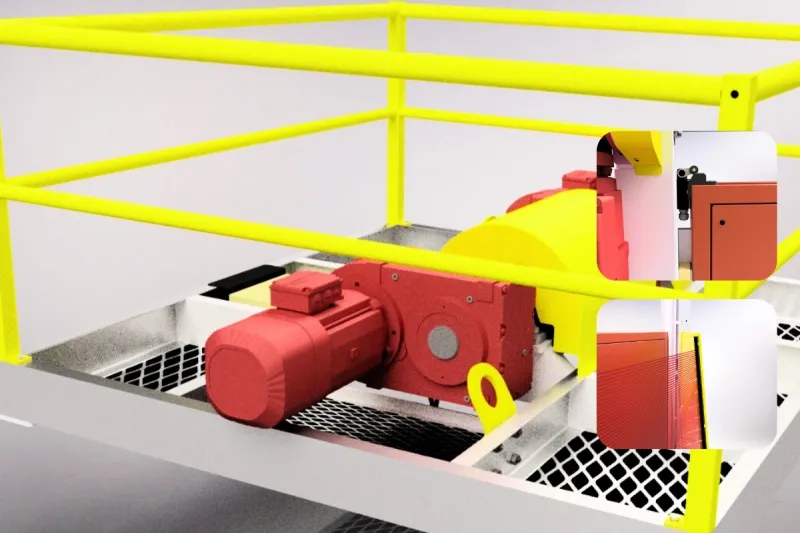
Safety features that make a difference.
Security is not optional. It's what underpins the entire operation.
Date: 30/April/2026
Reading time: 2 min
In vertical load handling, safety is not just a regulatory requirement; it's a critical element for ensuring the integrity of the operation, the people involved, and the entire industrial environment. In operations with a constant flow of materials, high weight, and integration with other production processes, any failure can generate significant impacts, both in terms of safety and productivity.
Therefore, MRSUL equipment is designed with a comprehensive safety approach, incorporating integrated components that act preventively, correctively, and immediately whenever necessary. More than just meeting standards, the goal is to anticipate risks and create a reliable, stable, and controlled operation at all times.
Among the main systems applied are devices such as anti-fall brakes, travel limiters, safety sensors, and emergency stop systems. These components do not act in isolation—they work in a synchronized manner, continuously monitoring the equipment's operation and ensuring rapid responses to any abnormality.
The anti-fall brake, for example, is essential to prevent abrupt movements or unexpected falls of the platform, offering an additional layer of protection in critical situations. Limit switches prevent the elevator from exceeding its operational limits, preserving the structure and avoiding mechanical damage. Safety sensors, in turn, detect obstacles, misalignments, or unsuitable conditions, while emergency stop systems allow for the immediate interruption of operation whenever necessary.
This combination of technologies ensures not only the interruption of operation under abnormal conditions, but also stability throughout the movement and operation within the correct parameters. As a result, there is a significant reduction in risks, increased equipment lifespan, and greater reliability for industrial routines.
Furthermore, all these systems are developed in accordance with the main applicable safety guidelines, such as NR-12, ensuring that the equipment is aligned with legal requirements and best industry practices.
Investing in high-quality safety components is a direct investment in operational continuity, employee protection, and the efficiency of the production process. In an increasingly demanding industrial environment, where performance and safety go hand in hand, every detail makes a difference—and can be decisive for the success of the operation.
Because, in the end, safety isn't just a differentiator. It's the foundation of everything.
MRSUL — engineering, technology, and safety applied to cargo handling.